



APPLICATION DETAILS
Introduction to Veneer & Plywood Terminology
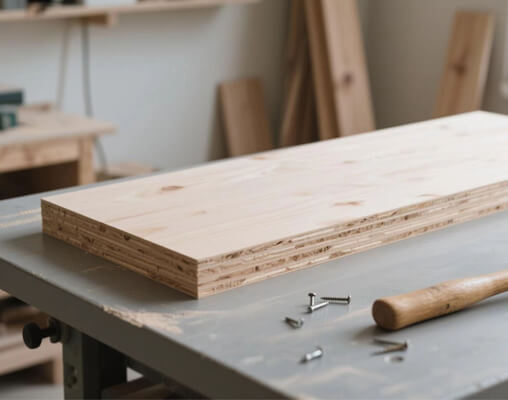
Plywood, a versatile engineered wood product, is constructed by bonding multiple layers of veneer—thin sheets of wood peeled, sliced, or sawn from logs—with adjacent grain directions perpendicular to one another. This cross-laminated structure enhances strength, stability, and resistance to warping, making plywood indispensable in construction, furniture, and design. Below is an optimized overview of key terms related to veneer production, plywood composition, joint types, grain patterns, and specialized plywood classifications. This guide clarifies technical terminology to enhance understanding of material properties, manufacturing techniques, and applications.

Veneer Production & Plywood Composition
Veneer
-
Loose side: The veneer surface contacting the peeling/slicing knife, often exhibiting slight roughness due to reverse stretching.
-
Face: The outer ply with superior aesthetic quality.
-
Back: The outer ply opposite the face, typically with minor visual imperfections.
-
Central ply: Core layer with symmetrical arrangement of adjacent plies.
-
Cross band/lateral ply: Inner plies with grain perpendicular to the face/back.
-
Longitudinal ply: Inner plies with grain parallel to the face/back.
-
Core: Thicker central layer in composite/sandwich panels (e.g., blockboard, honeycomb board).
Joints
-
Edge joint: Longitudinal splicing of veneers with aligned grain.
-
End joint: Veneers joined at ends, joint perpendicular to grain.
-
Scarf joint: Angled-edge bonding for seamless continuity.
-
Finger joint: Interlocking finger-shaped tenons for end-to-end connections.
Wood Grain
-
Straight grain: Fibers parallel to veneer length/width.
-
Angle grain: Fibers deviate from perpendicular alignment to edges.
-
Irregular grain: Distorted patterns due to abnormal wood structure.
Plywood Classifications
-
By Grain Orientation
-
Long-grained: Face grain parallel to board’s long edge.
-
Cross-grained: Face grain parallel to board’s short edge.
-
-
By Application
-
General-use: Versatile for non-specialized purposes.
-
Exterior: Weather-, moisture-, and humidity-resistant.
-
Interior: Not suitable for prolonged water exposure.
-
Structural: Engineered to meet mechanical strength requirements.
-
Decorative: Features aesthetic surface veneers (e.g., rare wood species).
-
-
By Core Design
-
Blockboard: Solid wood strip core.
-
Honeycomb board: Lightweight hexagonal core with cross-laminated faces.
-
Composite plywood: Core incorporates non-wood materials (e.g., foam, metal).
-
-
Specialized Types
-
Moulded plywood: Curved/formatted via die pressing.
-
Star plywood: Veneers radially arranged for uniform strength.
-
Scarfed/finger-jointed plywood: Extended dimensions via angled or interlocking joints.
-
Conclusion
Plywood’s adaptability arises from its layered design, customizable core materials, and diverse manufacturing techniques. From structural applications demanding rigidity to decorative uses prioritizing aesthetics, plywood’s classifications—such as exterior-grade moisture resistance or molded forms for ergonomic designs—address specific functional and visual requirements. Mastery of these terms empowers professionals to select optimal materials for projects, ensuring performance, durability, and cost-efficiency. As sustainability and innovation drive advancements in engineered wood, understanding these foundational concepts remains critical for architects, builders, and designers alike.
MESSAGE ONLINE
RELATED NEWS